Why your home phone plan costs more than the data you use
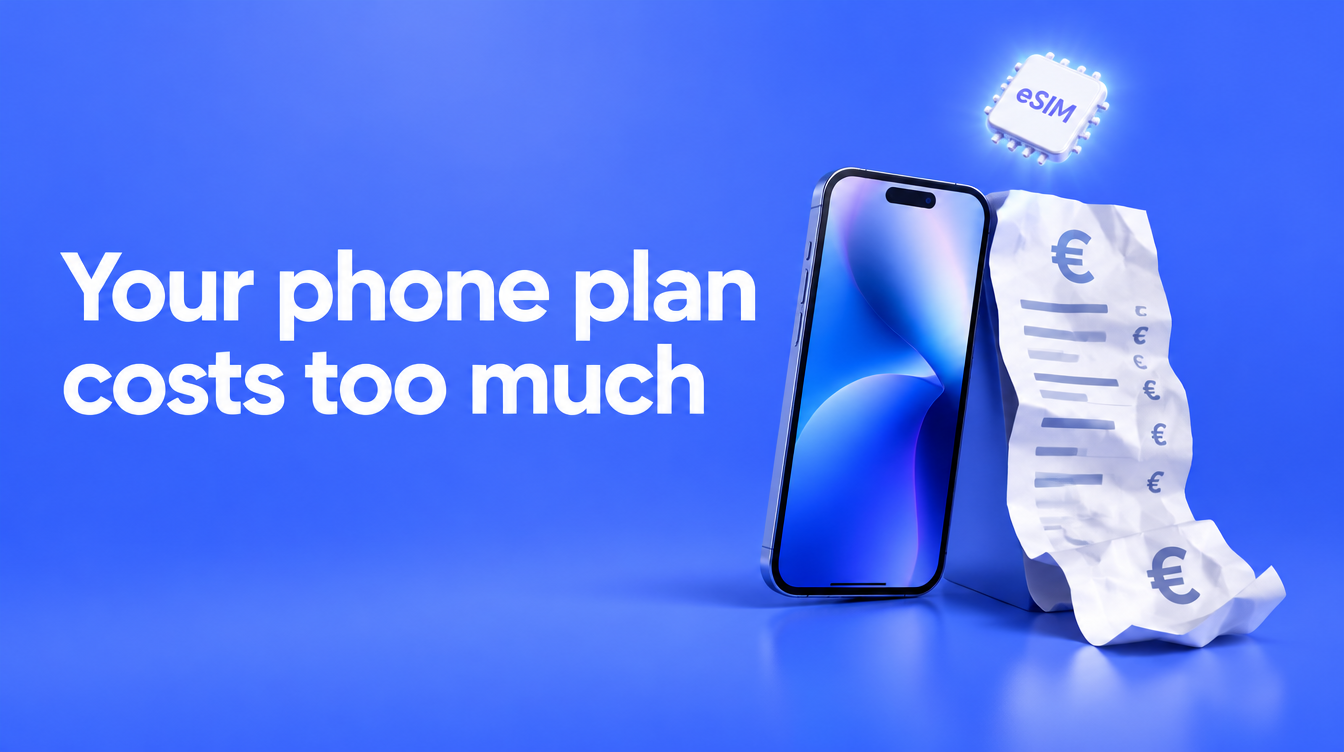
Short answer: most home phone plans in places like the UK and the US charge you for a number, a big data allowance and a contract, every month, whether you use it or not. If you travel a lot and mostly need data, one global eSIM plan that works in 100+ countries usually gives you more for less.
What are you actually paying for in a phone plan?
Three things, mostly.
1. A phone number. Useful. But less every year. Most of us call and text through WhatsApp, iMessage, Telegram or FaceTime. Banks still send codes by SMS, and that's about it.
2. A data allowance. Often big. Often "unlimited". Often much more than you use.
3. A contract. Twelve or twenty-four months. You pay the same every month, good month or quiet month.
Put those together and in many developed countries you land somewhere above 30 euros a month. Some people pay a lot more.
Is "unlimited" data really unlimited?
Not really. It's unlimited on paper.
Most "unlimited" plans come with a fair use policy. Go past a certain amount and your speed can be slowed down, or your traffic gets lower priority when the network is busy. Hotspot use is often capped separately.
And the biggest limit is the border. "Unlimited" usually means unlimited at home. Abroad you get a smaller roaming allowance, a daily fee, or nothing at all outside a list of countries.
So you pay for unlimited, and the moment you travel, it stops being unlimited.
What happens to your plan when you travel?
It depends on the carrier, but the patterns are the same.
- Roaming is included only in some countries.
- Outside that list, you pay a daily pass or per-MB rates.
- The roaming allowance is often a fraction of your home allowance.
- Some plans have no roaming at all unless you add it.
For someone who travels once a year, fine. For a digital nomad, an international entrepreneur or anyone who is on a plane every month, this is where the money goes.
How does a global eSIM change the math?
A global eSIM separates the two things you need. Keep your number on a cheap plan or a basic SIM. Get your data from one eSIM that works across borders.
With Super eSIM, one plan covers 100+ countries. Same eSIM, same app, you land and it works.
These are our current prices:
| Data | Price |
|---|---|
| 1 GB | €2.90 |
| 3 GB | €6.99 |
| 6 GB | €9.99 |
| 12 GB | €14.99 |
| 20 GB | €22.99 |
| 30 GB (30 days) | €27.99 |
| 50 GB | €35.99 |
The smallest plan costs less than a coffee in most European cities. If you're a light user, that's the whole bill.
(We also have a 100 GB plan valid 180 days for €99. That one covers 40 countries: the EU, USA and Albania, not the full 100+.)
Who should switch to a global eSIM?
Not everyone. Be honest about how you use your phone.
A global eSIM makes sense if:
- You travel abroad several times a year.
- You split time between two or more countries.
- You mostly use data, not minutes.
- You use under 10 to 15 GB a month in reality, not in theory.
Keep your big home plan if:
- You never leave the country.
- You use a lot of data at home, for example as your home internet.
- You need lots of local calls.
Not sure how much you use? Check your phone settings. Most phones show monthly mobile data. We wrote a whole guide on how much data you need on a trip.
Do I lose my phone number if I use an eSIM?
No. Most modern phones hold two lines. Keep your physical SIM for your number and SMS codes. Use the eSIM for data. Your WhatsApp stays linked to your number and runs on the eSIM's data.
Many people move their home line to the cheapest plan their carrier offers, just to keep the number alive. That alone can cut the monthly bill.
What about monthly plans and contracts?
Super eSIM has no contracts. You can turn on auto-renewal if you like a monthly rhythm, but it's optional.
Or you use auto top-up. When your data runs out, it tops up with the amount you chose. You pay when you use, not when the calendar says so. More on that in our auto top-up guide.
The simple way to think about it
Your phone plan was designed for a world where you stayed in one country and made phone calls.
If that's not your life anymore, you're paying for the wrong thing.
Keep the number cheap. Get your data from one plan that follows you. That's the idea behind what makes an eSIM a super eSIM.
FAQ
Are home phone plans expensive in the UK and US? Many plans in developed countries cost more than 30 euros a month, especially with large or unlimited data. Cheaper options exist, but they usually have small allowances and weak roaming.
Is unlimited mobile data really unlimited? Usually not. Most unlimited plans have fair use limits, hotspot caps, and much smaller allowances when roaming.
Can a global eSIM replace my phone plan? For data, yes. For your phone number, keep a cheap SIM. Most phones support both at once.
How many countries does Super eSIM cover? One plan works in 100+ countries. The 100 GB and 15 GB offers cover 40 countries (EU, USA and Albania).
Do I need a contract? No. Auto-renewal and auto top-up are both optional.